
Home Use vs Professional Hair Removal Machine: Can a Home Device Replace a Clinic Machine?
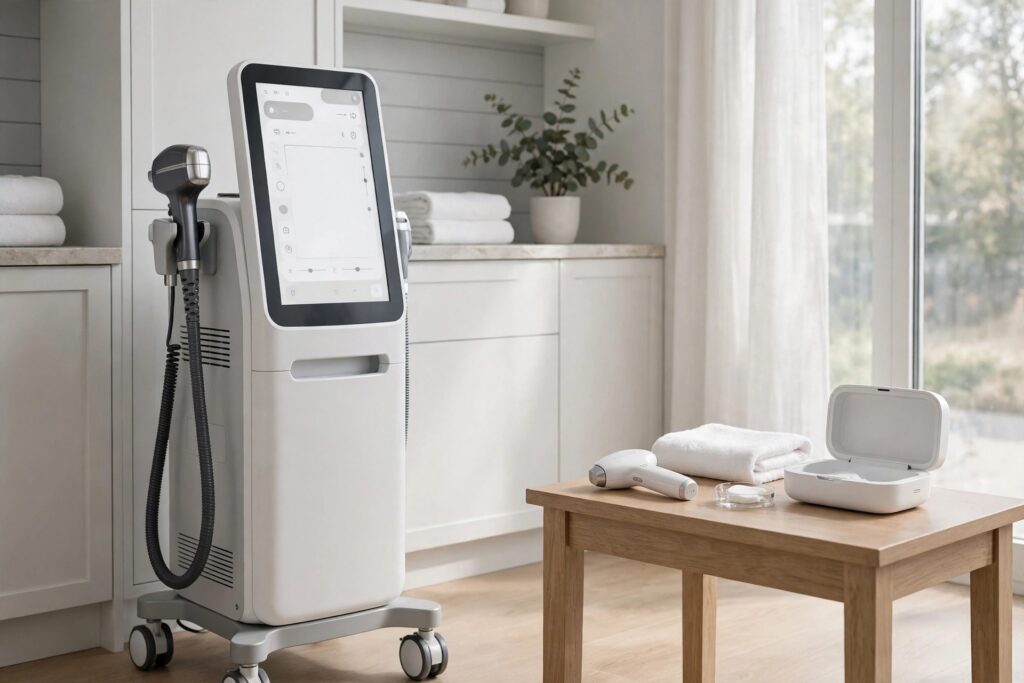
No — a home hair removal device cannot replace a professional machine for clinic use. Home devices are low-energy tools for personal maintenance on small areas; professional machines deliver higher power, larger spots, and active cooling for back-to-back clinic sessions. The right question is not which is better, but which job each one does: home devices maintain, professional machines treat.
A home-use hair removal device is a personal, low-energy IPL or laser tool for maintenance on small areas; a professional machine is a high-power, operator-controlled system built for clinic courses and commercial throughput.
Can a home device replace a professional machine?
Short answer: no, not for a clinic service — and yes, for personal maintenance between clinic courses. The two are different categories built for different jobs, not two versions of the same tool.
A home device is built for one person using it on themselves, occasionally, on a small area. A professional machine is built for a trained operator treating client after client, all day, on any area, under a protocol with screening, settings, and follow-up. That difference shows up in power, spot size, cooling, and throughput — the four things that decide how many sessions a course takes and what each session can do.
This matters commercially because your clients will ask the question. A client who has seen a home device online will ask why a clinic course costs more. The comparison below is the answer: it is not the same treatment at a different price, it is a different tool for a different job.
Home vs professional at a glance
| Factor | Home-use device (category general) | Professional machine (as listed on SKBTY) |
|---|---|---|
| Energy and power | Lower energy, capped for safe self-use by untrained users | 1800–2000W listed on the 808nm diode range; fluence 1–200 J/cm² (Portable 808nm) |
| Spot size | Small treatment window, suited to small areas; large areas take many passes | Up to 13 × 30 mm (SK-808-D03); 21 × 19 mm plus a precision head (156WF-2T) |
| Cooling | Basic skin-contact cooling, or none stated | TEC + semiconductor + air/water cooling; contact cooling approx. 5°C (SK-808-D03) |
| Sessions | Many more sessions; positioned for maintenance, not a full course | A course of treatments under a clinic protocol |
| Operator | Self-use, no training required | Trained operator; consultation and test spot before a course begins |
| Throughput | One person, occasional use | Back-to-back sessions, commercial use |
| Certification and support | Consumer product standards for personal use | Certificate for the exact model and your market; training, warranty, and spare parts |
| Cost | Low upfront cost, personal purchase | $1,399–$6,999 listed (SKBTY professional range); a commercial investment, priced per course |
What a home device can and cannot do
What it can do. A home device can maintain results on a small area between clinic courses, and it can suit a person who wants a low-cost, at-home routine and accepts a longer schedule. For personal use on a small area, that is a legitimate job — it is simply not the clinic’s job.
What it cannot do. It cannot replace a clinic course: lower energy and a smaller window mean more sessions for the same area, and it is not built for back-to-back commercial use. It cannot replace professional screening — skin type, hair characteristics, and suitability still need a consultation and a test spot. And it cannot serve a clinic’s clients: a device built for one person’s occasional use is not a service-menu asset.
One honest note for clinics: some clients will buy a home device anyway. That is not lost revenue — it is a maintenance customer. A clinic that explains the difference clearly keeps the course sale and gains a client who understands what the professional treatment is for.
What a professional machine does differently
The professional difference is engineering, not branding. Compare the SKBTY professional range (checked 2026-11-17 via the WooCommerce API):
| Model | Technology | Key listed facts |
|---|---|---|
| Portable 808nm Diode Laser | 808nm diode laser | 1800W; 12 × 12 mm spot; 1–200 J/cm²; air + water + semiconductor cooling |
| 156WF-2T Three-Head 808nm | 808nm diode laser | 2000W listed; three interchangeable heads; semiconductor + air + TEC cooling; 5 L water tank |
| SK-808-D03 Triple-Wavelength | 755 / 808 / 1064nm diode laser | 2000W; 13 × 30 mm spot; 1–50 J/cm²; contact cooling approx. 5°C; 50,000,000-operation rating listed |
| SK-M22-02 Single-Handle IPL | IPL | 9 interchangeable filters; non-ablative; hair removal is one of its indications (640 nm filter) |
| SK-M22-01 Dual-Handle IPL + Q-Switch | IPL + Q-switch laser | 9 IPL filter bands + 5 laser probes; Q-switch 10–20 ns; mobile cart |
Two things to notice. First, wavelength choice: the SK-808-D03 page maps 755nm to fair skin and golden hair, 808nm to yellow skin tones and brown hair, and 1064nm to dark or yellow skin tones and black hair — a home device offers no such matching. Second, cooling: TEC refrigeration and contact cooling near 5°C let the operator use effective fluence comfortably, session after session. That is what a course is built on.
For the full selection logic, see the 808nm Diode Laser Hair Removal Machine Buying Guide and the DPL/IPL Machine Buying Guide.
How much does a professional hair removal machine cost?
Prices below are SKBTY catalogue listings checked 2026-11-17 via the WooCommerce API. Confirm the final quote, shipping, and included accessories with the supplier before budgeting. No home-use hair removal machine is listed in this table — SKBTY does not sell one, so no home price is quoted here.
The professional range runs $1,399–$6,999. The price follows the technology and the handle count, not the size of the box. For what drives the price — diode source quality, cooling, certification, total cost of ownership — see 808nm Diode Laser Hair Removal Machine Price.
What should a clinic check before buying a hair removal machine?
| Check | What to ask | SKBTY example (as listed) |
|---|---|---|
| Technology | Diode laser, IPL, or a dual-function system — which fits the service you sell? | Diode (808nm range); IPL (SK-M22-02); IPL + Q-switch (SK-M22-01) |
| Wavelength coverage | Single 808nm, or 755/808/1064nm triple for a wider client mix? | 808nm only (Portable, 156WF-2T); triple (SK-808-D03) |
| Power and spot size | Listed power, spot size, fluence, pulse width? | 1800–2000W; spots up to 13 × 30 mm; fluence 1–200 J/cm² |
| Cooling | Contact cooling temperature and architecture? | Approx. 5°C contact cooling (SK-808-D03); TEC + semiconductor + air/water (range) |
| Throughput | Is the machine built for back-to-back commercial sessions? | Cooling architecture and water tank (5 L, 156WF-2T) decide this — confirm in quotation |
| Applicators | Which heads are included, and what does each do? | Three interchangeable heads (156WF-2T); one handpiece (Portable, SK-808-D03) |
| Certification | Certificate covering your market and the exact model? | Ask the supplier for the certificate covering the exact model |
| Total cost | Shipping, duties, consumables, training, downtime? | See the price table above; confirm the final quote in writing |
How to answer the client who asks “why not just buy a home device?”
Three short answers a clinic can use in consultation:
1. “The machine decides the result per session, not the number of sessions.” Professional power, spot size, and cooling decide how much energy reaches the follicle each visit. A home device needs many more passes for the same area because it is built to be safe in untrained hands — that is a design limit, not a setting you can change.
2. “You are buying a course, not a gadget.” A clinic course includes screening, wavelength and setting selection for your skin and hair, a test spot, and follow-up across the hair growth cycle. The machine is one part; the protocol is the product.
3. “A home device has a place — after the course.” Maintenance on a small area between clinic courses is exactly what home devices are for. Positioning it that way keeps the course sale and gives the client an honest use for the cheaper tool, instead of a false choice between the two.
FAQ
Can a home IPL device replace a professional laser for hair removal?
Not for clinic use. A home device is a low-energy personal tool for maintenance on small areas; a professional machine delivers higher power, a larger spot, and active cooling for back-to-back clinic sessions under a protocol. The two do different jobs.
Why is a professional machine so much more expensive?
Power, cooling, spot size, wavelength choice, certification, training, and support. The SKBTY professional range lists $1,399–$6,999; the price follows the technology and handle count. A clinic buys throughput and protocol, not just a device.
Can a clinic sell home devices to clients?
Some clinics retail a maintenance device for use between courses. SKBTY does not list a home-use hair removal machine, so this article names no home product and quotes no home price. If you retail one, position it as maintenance after the course — not as a substitute for it.
Does a home device work on all skin and hair types?
Home devices are designed for a narrower range of skin and hair, and suitability still needs screening. This guide makes no efficacy promise for any device or any skin or hair type — confirm suitability in consultation, including a test spot.
How many sessions does professional hair removal take?
A course of treatments, not a single session — hair grows in cycles, and only follicles in the active phase are affected at each visit. The number varies by client, area, and protocol; confirm the expected course during consultation.
What certification should I ask for?
Ask the supplier for the certificate covering the exact model and your market. No FDA claim is made for these models in this article — if you need a specific certification for your market, ask for the document, not the claim.
Internal links: 808nm Diode Laser Hair Removal Machine Buying Guide · DPL/IPL Machine Buying Guide · Laser Tattoo Removal Machine Buying Guide · Hair Removal Machines · 808nm Diode Laser Hair Removal Machine Price · Hair Removal Machine Buying Guide for Clinics and Salons · Professional vs Home-use Beauty Devices
Sources (checked 2026-11-17): WooCommerce API get-product 4259 / 3449 / 1678 / 3106 / 4338 / 4282 / 2151 / 2752 / 3120 / 3144 (prices, stock, short descriptions) + list-products (Hair Removal Machines category, 9 products; Four Wavelengths 3053 is draft with no price — excluded) · WP API pages 3686 (Hair Removal Machine Buying Guide for Clinics and Salons) and 3693 (Professional vs Home-use Beauty Devices) read to avoid duplication — this article is the hair-removal-specific home-vs-professional comparison, not another general buying guide · post-sitemap + page-sitemap + wp-json posts/pages search (slug home-use-vs-professional-hair-removal-machine: no conflict) · all 7 internal-link targets verified HTTP 200 on 2026-11-17 · home-use side states category generics only (no models, no prices — SKBTY sells no home-use hair removal machine).