
Laser Tattoo Removal Machine Buying Guide: Q-Switched vs Picosecond, Wavelengths, and What to Check Before Buying
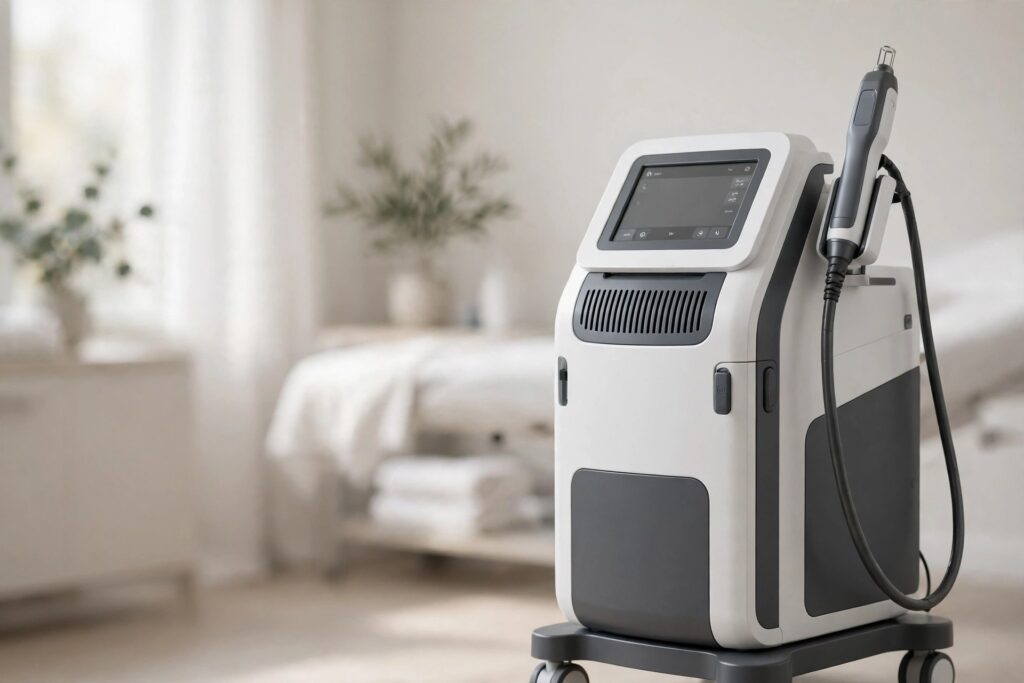
A laser tattoo removal machine is worth buying when your clinic or studio removes tattoos or permanent makeup regularly and has a trained operator. Choose by pulse width first — picosecond vs Q-switched nanosecond — then by wavelengths, then by cooling and spot size. Confirm the exact model’s documentation and certification before ordering.
Citable definition (31 words): A laser tattoo removal machine is a professional device that fires short laser pulses into tattoo ink, shattering it into fine particles the body clears over the following weeks.
What is a laser tattoo removal machine?
A laser tattoo removal machine sends short pulses of light into the skin. The tattoo ink absorbs the energy and shatters into particles small enough for the body to clear naturally over the following weeks. The product pages on skbty.com describe this the same way: short pulses, ink absorbs the energy, pigment breaks into fine particles.
The pulse is the whole technology. A shorter pulse concentrates the energy in time, so the ink shatters with less heat spreading into the surrounding skin. That is why the first question to ask any supplier is the exact pulse width in writing — picosecond or nanosecond, and how many picoseconds or nanoseconds — not “advanced laser” in marketing words.
Q-switched vs picosecond — which should your clinic choose?
| Factor | Picosecond | Q-switched (nanosecond) |
|---|---|---|
| Pulse width | Picosecond domain — e.g. 2,000 ps on the ND YAG Picosecond, roughly 1% of a traditional nanosecond pulse (per its product page) | Nanosecond domain — e.g. 1–10 ns as listed on the SK-P-01; SK-P-02 and SK-P-03 list Q-Switch Nd:YAG with no ps/ns figure on the page |
| How it works | Ultra-short pulse shatters pigment into microscopic fragments | Short pulse breaks pigment with a photomechanical + photothermal effect |
| Best for | Clinics that want the shortest pulse class for stubborn or multi-colour ink | Clinics that want a proven, lower-cost route |
| skbty example (as listed) | ND YAG Picosecond 2000W — the only one of the four with a picosecond figure on its page | SK-P-01 portable (1–10 ns as listed); SK-P-02 and SK-P-03 (Q-Switch Nd:YAG, pulse width not stated) |
Do not compare two machines by “picosecond” in the name alone. One listing can sit in the picosecond category while its specification sheet lists a nanosecond pulse duration — the SK-P-01 is the example on this site. Read the specification table, not the category label.
Which wavelength removes which ink?
| Wavelength | What it targets (as listed) | skbty example |
|---|---|---|
| 1064nm | Black and dark ink; deepest penetration | All four models below |
| 532nm | Red, orange and warm-colour ink | All four models below |
| 1320nm | Carbon peeling (“Black Doll”) and pigment toning | ND YAG (optional), SK-P-02, SK-P-01, SK-P-03 |
| 785nm | Optional add-on wavelength | ND YAG Picosecond (optional) |
A single wavelength cannot cover every tattoo. A buyer whose clients bring multi-colour work should ask which wavelengths are included in the quoted configuration — standard vs optional — because an optional wavelength bought later costs more than one ordered with the machine.
Four machines on skbty.com, compared
Prices below are skbty.com listings checked 2026-11-15. All four are quote-based: the product pages show no sale price, so request a written quote and confirm which handpieces and accessories are included.
Energy note: the four pages state energy in different units — J, J/cm² and mJ — so the figures below are listed per model exactly as published and must not be read as a directly comparable ranking.
| Model | Pulse width | Wavelengths | Energy (as listed, units differ) | Frequency | Cooling | Power |
|---|---|---|---|---|---|---|
| ND YAG Picosecond Laser Tattoo Removal Machine | 2,000 ps | 532 / 1064nm standard; 785 / 1320nm optional | Max 2.0 J | 1–10 Hz | Air + water | 2,000W; 10.1-inch screen; spot 2–10 mm |
| Pico Laser Tattoo Removal Machine SK-P-02 | Not stated on the page (Q-Switch Nd:YAG) | 1064 / 532 / 1320nm | 30–1500 J/cm² | 1–10 Hz | Water + air | 500W; 4.3-inch colour touchscreen; 5 treatment handpieces |
| Pico Laser Treatment Tattoo Removal SK-P-03 | Not stated on the page (Q-Switch Nd:YAG) | 1064 / 532 / 1320nm | 30–1500 J/cm² | 1–10 Hz | Water + semiconductor + air | 500W; 4.3-inch touchscreen; 3 treatment handpieces (1064 / 532 / 1320) |
| Portable Tattoo Removal Laser Machine SK-P-01 | 1–10 ns (as listed) | 1320 / 1064 / 532nm | 0–1500 mJ adjustable | 1–10 Hz | Wind + water | 500W; 15 kg benchtop |
The range is wide because the machines do different jobs: a 2,000W picosecond flagship, two 500W five-/three-handpiece systems, and a 15 kg portable unit. Compare prices only between machines built for the same service.
What should a clinic check before buying a laser tattoo removal machine?
| Check | What to ask | skbty example (as listed) |
|---|---|---|
| Pulse width | Exact figure in writing — ps or ns? | 2,000 ps (ND YAG); 1–10 ns (SK-P-01); not stated on the page (SK-P-02, SK-P-03) |
| Wavelengths | Which are standard, which are optional? | 532 / 1064nm standard on the ND YAG; 785 / 1320nm optional; SK-P-03 ships with 3 probes (1064 / 532 / 1320) |
| Energy / fluence | Max energy and adjustable range, in which unit? | Max 2.0 J (ND YAG); 30–1500 J/cm² (SK-P-02, SK-P-03); 0–1500 mJ (SK-P-01) — units differ, do not compare directly |
| Spot size | Adjustable range? | 2–10 mm (ND YAG) — confirm for the exact model |
| Frequency | Adjustable range? | 1–10 Hz on all four models |
| Cooling | Built-in cooling type? | Air + water (ND YAG); water + air (SK-P-02); water + semiconductor + air (SK-P-03); wind + water (SK-P-01) |
| Handpieces | Which are included, and what does each do? | 5 treatment handpieces (SK-P-02); 3 treatment handpieces (SK-P-03) |
| Intended use | Cosmetic, wellness, or other use — as stated in the manual? | Confirm the intended-use documentation for the exact model |
| Certification | Model-specific certificate? | Ask the supplier for the certificate covering the exact model |
| After-sales | Training, warranty terms, spare parts? | Confirm in writing before ordering |
How much does a laser tattoo removal machine cost?
skbty.com does not publish machine prices for these four models — all show quote-based pricing. Request a written quote that lists the included wavelengths, handpieces, cooling, and accessories, and confirm shipping before budgeting. Do not budget from a competitor’s headline price: a quote that omits an optional wavelength or a handpiece is not the same machine.
What clients pay per session is a different question, and skbty already answers it: Price of Laser Tattoo Removal: What You’ll Actually Pay explains tiered per-session pricing — each session is priced around how much work the specific tattoo needs, and tattoos needing several wavelengths take more sessions and cost more in total. Use that article when a client asks what removal costs; use a supplier quote when your clinic asks what the machine costs.
FAQ
Is picosecond always better than Q-switched? Not always. Picosecond is the shorter pulse class, and the ND YAG page states its 2,000 ps pulse is roughly 1% of a traditional nanosecond pulse. But the right choice depends on the ink, the budget, and whether the machine must do other work. Compare the exact pulse width and wavelengths, not the label — and note that only the ND YAG of the four models above actually publishes a picosecond figure.
How many sessions does tattoo removal take? It varies by ink colour, tattoo size, ink depth, and how many wavelengths the work needs. skbty’s price article notes that tattoos needing several wavelengths take more sessions and a higher total. Follow the machine’s operating instructions and run a proper consultation — this article makes no efficacy claims.
Can one machine remove every ink colour? No single wavelength covers every colour. 1064nm targets black and dark ink, 532nm targets red and warm colours, 1320nm is used for carbon peeling. Check which wavelengths are included in the quoted configuration before ordering.
Can it remove permanent makeup? The SK-P-01 lists permanent makeup removal among its applications, alongside tattoo clearing and carbon skin toning. Confirm the intended-use documentation for the exact model and follow the operator’s instructions.
Is laser tattoo removal suitable for every skin type? No treatment suits every client. Follow the machine’s operating instructions, contraindications, and operator training, and run a proper consultation. This article makes no medical or efficacy claims.
Does skbty’s tattoo removal equipment carry FDA clearance? No FDA claim is made on these product pages, and this article makes none. The site header states devices meet “FDA or CE compliance” in general terms; if you need a specific certification for your market, ask the supplier for the certificate covering the exact model.
Related reading: Price of Laser Tattoo Removal · ND YAG Picosecond · SK-P-02 · SK-P-03 · SK-P-01 · 808nm Diode Laser Hair Removal Machine Price · Skin Analysis Equipment for Clinics
Sources (checked 2026-11-15): skbty.com product pages for ND YAG Picosecond (2,000 ps, 532/1064nm standard, 785/1320nm optional, max 2.0 J, 1–10 Hz, spot 2–10 mm, 10.1-inch screen, air + water cooling, 2,000W), SK-P-02 (1064/532/1320nm, 30–1500 J/cm², 1–10 Hz, 5 handpieces, 4.3-inch touchscreen, water + air cooling, 500W), SK-P-03 (Q-Switch Nd:YAG, 1064/532/1320nm, 30–1500 J/cm², 1–10 Hz, 3 probes, 4.3-inch touchscreen, water + semiconductor + air cooling, 500W), SK-P-01 (1320/1064/532nm, 0–1500 mJ, 1–10 ns as listed, 1–10 Hz, wind + water cooling, 15 kg, 500W); skbty.com price article (published 2026-09-29); GSC via gsc-proxy sync 2026-11-15 (window 2026-10-16~11-12).