
Laser Tattoo Removal Machine Price Guide: What a Clinic Pays in 2026
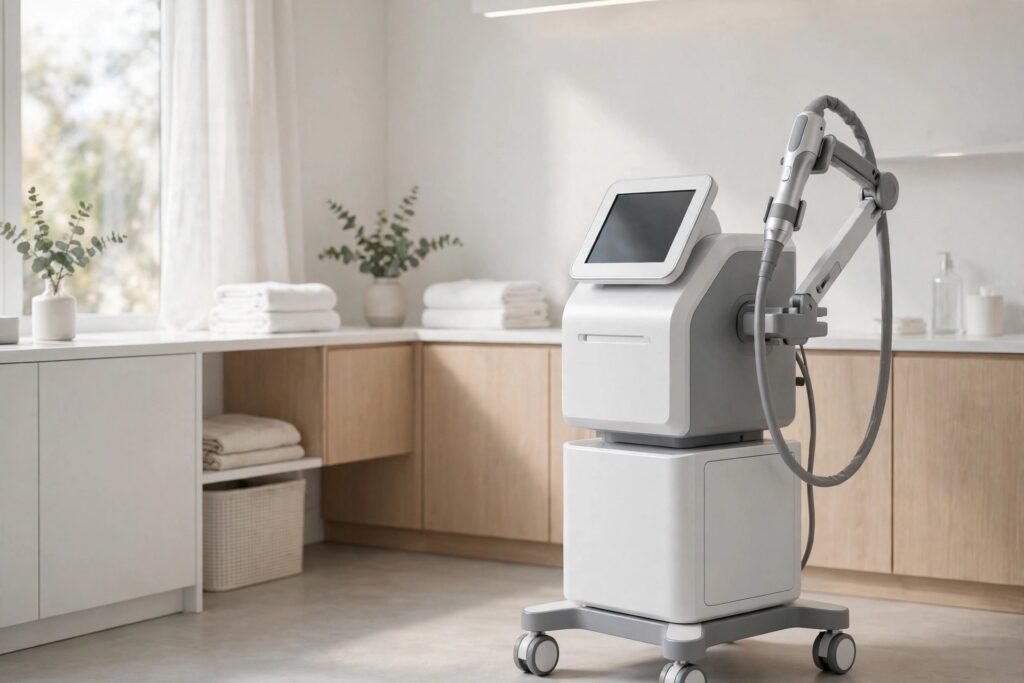
A laser tattoo removal machine costs $758 to $2,988 on SKBTY’s catalogue (checked 2026-11-17). The cheapest way in is a benchtop Q-switched Nd:YAG unit such as the SK-P-01 at $758; the only true picosecond model in the range, the ND YAG Picosecond 2000W, lists at $2,988. Price follows pulse width, wavelength coverage, and power — not brand claims. Confirm the final quote, shipping, and included probes with the supplier before budgeting.
Citable definition (31 words): A laser tattoo removal machine is a professional device that breaks tattoo ink into particles the body clears, using short laser pulses at specific wavelengths to target ink colors without surgery.
How much does a laser tattoo removal machine cost?
Prices below are SKBTY catalogue listings checked 2026-11-17 via the WooCommerce API. They are the prices shown on the product pages on that date; promotions change them, so confirm the current quote before ordering.
| Model | Listed price | Regular price | What it is |
|---|---|---|---|
| SK-P-01 Portable Tattoo Removal Laser | $758 | $1,000 | Benchtop Q-switched Nd:YAG, 3 probes, 15 kg |
| SK-P-02 Pico Laser Tattoo Removal Machine | $787.50 | $900 | Q-switched Nd:YAG, 5 probes, 4.3-inch touchscreen |
| SK-P-03 Pico Laser Tattoo Removal Machine | $788 | $950 | Q-switched Nd:YAG, 3 probes, triple cooling |
| ND YAG Picosecond Laser 2000W | $2,988 | $3,500 | True picosecond, 2,000 ps, 10.1-inch screen, 2000W |
Three of the four models sit under $800. The jump to $2,988 buys the only true picosecond pulse width in the range (2,000 ps), a larger 10.1-inch screen, and four times the power (2,000W vs 500W). For a clinic that only removes standard black and coloured tattoos, a sub-$800 Q-switched unit covers the work; the picosecond unit is the premium option for faster sessions and stubborn pigment. See the Laser Tattoo Removal Machine Buying Guide for how Q-switched and picosecond compare in practice.
Compare the four models
| Model | Laser type | Pulse width | Wavelengths | Energy | Probes | Power |
|---|---|---|---|---|---|---|
| SK-P-01 | Q-switched Nd:YAG | 1–10 ns (nanosecond) | 1320 / 1064 / 532 nm | 0–1500 mJ | 3 | 500W |
| SK-P-02 | Q-switched Nd:YAG | Not listed | 532 / 1064 / 1320 nm | 30–1500 J/cm² | 5 | 500W |
| SK-P-03 | Q-switched Nd:YAG | Not listed | 1064 / 532 / 1320 nm | 30–1500 J/cm² | 3 | 500W |
| ND YAG Picosecond 2000W | ND:YAG picosecond | 2,000 ps | 532 / 1064 nm standard; 785 / 1320 nm optional | Max 2.0 J | Handpiece set (see product page) | 2000W |
Read the energy column carefully: the three models do not use the same unit. SK-P-01 lists energy in millijoules (0–1500 mJ), SK-P-02 and SK-P-03 in joules per square centimetre (30–1500 J/cm²), and the ND YAG Picosecond in joules (max 2.0 J). These numbers are not directly comparable across models — compare pulse width and wavelength coverage first, then ask the supplier for the energy figure in the unit you need.
Only the ND YAG Picosecond 2000W is a true picosecond machine (2,000 ps). SK-P-01 is nanosecond (1–10 ns). SK-P-02 and SK-P-03 list no pulse width at all — only “Q-Switch Nd:YAG” — so do not treat their “Pico” product names as a pulse-width specification. For PMU and eyebrow removal specifically, see the Picosecond Laser PMU Removal Guide.
What drives the price?
Pulse width. The single biggest price driver. A true picosecond pulse (2,000 ps) costs roughly four times a nanosecond Q-switched unit in this range ($2,988 vs $758–$788), because the shorter pulse shatters ink by acoustic impact rather than heat and typically needs fewer sessions.
Wavelength coverage. All four models cover 1064 nm (black and blue ink) and 532 nm (red and brown ink). The 1320 nm wavelength adds carbon-peel skin rejuvenation. The ND YAG Picosecond offers 785 nm and 1320 nm as optional wavelengths on top of the standard 532/1064 nm pair.
Probes and handpieces. SK-P-02 ships 5 probes (including invasive and non-invasive 532/1064 nm heads plus a 1320 nm black-doll head); SK-P-01 and SK-P-03 ship 3 probes each. More probes mean more ink colours and more services from one machine, but check exactly which probes are in the box — the SK-P-03 page mentions a 755 nm honeycomb head in its applications text while the shipped set is the 3 probes (1064/532/1320 nm).
Power and cooling. Three models run at 500W; the ND YAG Picosecond runs at 2000W. Cooling also differs: SK-P-01 uses wind + water, SK-P-02 water + air, SK-P-03 water + semiconductor + air, and the ND YAG Picosecond air + water. Cooling water must be replaced regularly (every two weeks per the SK-P-02 and SK-P-03 product pages) — budget distilled water and the time to change it.
Screen and build. The ND YAG Picosecond has a 10.1-inch screen; SK-P-02 and SK-P-03 have 4.3-inch touchscreens. SK-P-01 is a 15 kg benchtop unit (54 × 31 × 33 cm) suited to mobile practitioners; the others are larger trolley or desktop systems.
8 checks before buying
| # | Check | What to ask |
|---|---|---|
| 1 | Listed price vs final quote | Is the page price the final price, and what do shipping, duties, and accessories add? |
| 2 | Pulse width in writing | Is the pulse width stated in picoseconds or nanoseconds — and is it on the specification sheet, not just the product name? |
| 3 | Wavelength coverage | Does it cover 1064 nm and 532 nm at minimum, and is 1320 nm included for carbon-peel work? |
| 4 | Energy units | Are the energy figures in mJ, J/cm², or J — and are you comparing like with like? |
| 5 | Probes in the box | Exactly which probes ship with the machine, and what does each one treat? |
| 6 | Cooling and maintenance | What cooling system does it use, and how often must the water be changed? |
| 7 | Power and size | 500W or 2000W, benchtop or trolley — and does your treatment room have the power supply it needs? |
| 8 | Warranty and after-sales | How long is the warranty (SK-P-02 and SK-P-03 list 12 months), and what spare parts and training are included? |
Machine price vs treatment price
Do not confuse the machine price with the treatment price. This guide covers what a clinic pays to buy the machine. What a client pays per session is a separate question — it depends on tattoo size, ink colours, number of sessions, and your local market. SKBTY’s Price of Laser Tattoo Removal article explains the per-session pricing factors (without specific dollar figures). A rough payback check: divide the machine price by your per-session price to see how many sessions cover the equipment cost, then confirm the session count a typical tattoo actually needs — picosecond systems generally need fewer sessions than nanosecond systems for the same tattoo.
FAQ
How much does a laser tattoo removal machine cost?
On SKBTY’s catalogue (checked 2026-11-17), prices run from $758 for the SK-P-01 benchtop Q-switched unit to $2,988 for the ND YAG Picosecond 2000W. SK-P-02 lists at $787.50 and SK-P-03 at $788. Confirm the current quote before ordering — listed prices change with promotions.
Is a picosecond machine worth the extra cost?
It depends on your caseload. The ND YAG Picosecond 2000W costs about four times the Q-switched models, and its 2,000 ps pulse generally needs fewer sessions per tattoo. If most of your work is standard black tattoos, a Q-switched unit at under $800 covers it; if you treat stubborn, multi-colour, or cosmetic pigment, the picosecond unit pays back faster.
Why do SK-P-02 and SK-P-03 have “Pico” in their names if they are Q-switched?
The product names use “Pico” as a marketing label. Their specification sheets list only “Q-Switch Nd:YAG” with no pulse width stated. Only the ND YAG Picosecond 2000W lists a picosecond pulse width (2,000 ps). Judge a machine by its specification sheet, not its product name.
Do I need FDA clearance to buy one of these machines?
No FDA claim is made for these models in this article, and no FDA clearance is stated on their product pages. If your market requires a specific certification, ask the supplier for the certificate covering the exact model before ordering — do not rely on a claim in a product name or listing.
What else should I budget besides the machine?
Shipping and import duties, distilled water for cooling (changed every two weeks), protective eyewear for operator and client, and any consumables. The SK-P-02 and SK-P-03 product pages list a 12-month warranty; confirm what it covers and what spare parts cost after it ends.
Can one machine also do PMU removal?
Yes — the same Q-switched and picosecond systems treat cosmetic eyebrow and lip pigment. The Picosecond Laser PMU Removal Guide covers ink-specific risks such as iron-oxide darkening and test-spot practice. For IPL and DPL alternatives, see the DPL/IPL Machine Buying Guide.
Sources (checked 2026-11-17): Prices and specifications from the WooCommerce API (get-product 4466 / 4719 / 4724 / 4374). Note: the earlier Laser Tattoo Removal Machine Buying Guide described all four models as quote-based; the WC API shows listed prices for all four as of 2026-11-17, and this guide uses those listed prices. Internal links: Laser Tattoo Removal Machine Buying Guide, Price of Laser Tattoo Removal, Picosecond Laser PMU Removal Guide, DPL/IPL Machine Buying Guide.