
CO2 Fractional Laser Machine Buying Guide: RF Metal Tube vs Glass Tube and How to Choose
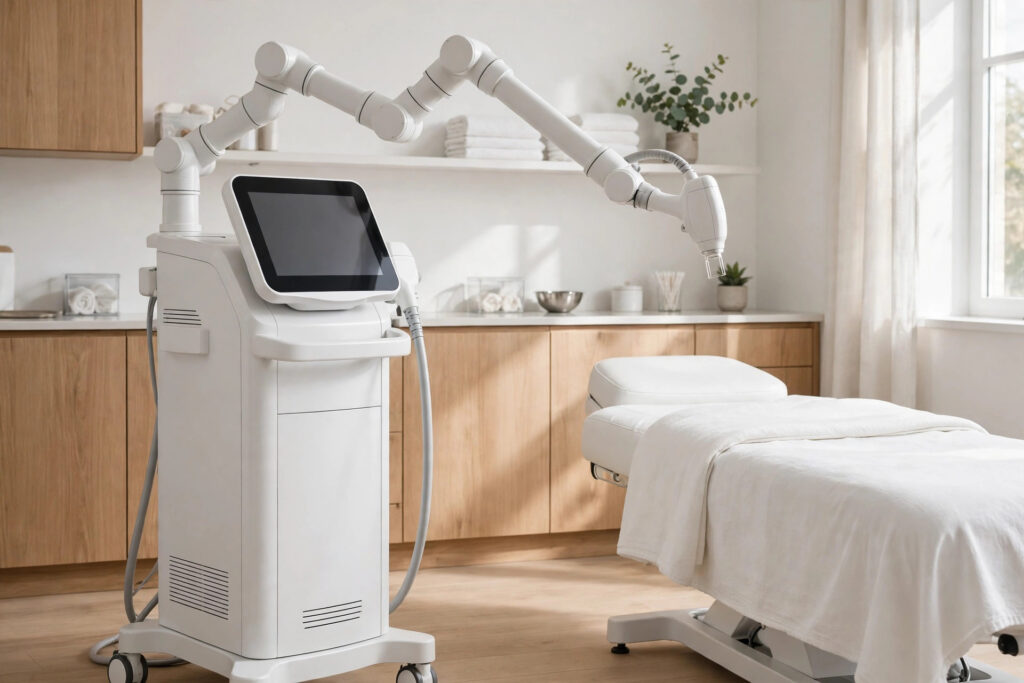
A CO2 fractional laser machine is worth buying when your clinic sells skin resurfacing, scar revision, and intimate tissue care and has a trained operator. Choose by laser tube type first, then by power and delivery arm: RF metal tube systems suit heavy clinical use, glass tube systems suit a lower budget, and a 6- or 7-joint articulated arm decides how precisely the beam reaches the treatment area. Confirm the documentation and certification for your market before ordering.
A CO2 fractional laser machine is a professional device that sends a 10,600 nm carbon dioxide laser beam in a fractional pattern — a grid of microbeams that leaves surrounding skin intact — to support skin resurfacing, scar revision, and tissue remodeling.
What is a CO2 fractional laser?
A CO2 laser emits infrared light at 10,600 nm, a wavelength strongly absorbed by water in tissue. “Fractional” means the beam is split into a grid of microbeams: each microbeam creates a controlled micro-thermal zone, while the skin between the beams stays intact and supports repair. The result is resurfacing with less downtime than a fully ablative CO2 treatment.
The listed applications on the SKBTY models are skin resurfacing, scar revision, tissue tightening, and intimate tissue care. It is a clinical device: the operator must be trained, the settings must be selected per client, and the treatment plan depends on the skin condition. This guide covers the equipment, not medical advice.
RF metal tube vs glass tube — which should your clinic choose?
The laser tube is the core component. RF metal tube lasers and glass tube lasers differ in durability, stability, and price.
| Factor | RF metal tube | Glass tube |
|---|---|---|
| Durability | Longer tube life; sealed metal construction | Shorter tube life; glass tube is a consumable |
| Stability | More stable beam over the tube’s life | Output can fall as the tube ages |
| Price | Higher purchase price | Lower purchase price |
| Best for | Heavy clinical use; a clinic buying for the long term | A lower budget; a clinic testing CO2 services |
| SKBTY example (as listed) | CO2 Fractional Laser Machine Portable (RF metal tube), $3,789 | SK-ZGV18 40W glass tube, $2,288; 30W Desktop glass tube, $1,769 |
Buy RF metal tube when the machine will run daily and the clinic wants a long tube life. Buy glass tube when the budget is limited and the clinic accepts a shorter tube life and replacement cost.
Which CO2 fractional laser machine should you buy?
Compare the SKBTY range (checked 2026-11-16 via the WooCommerce API). Prices are catalogue listings; confirm the final quote, shipping, and included handpieces with the supplier before budgeting. Wattage is stated only where the product listing is consistent; where the listing conflicts, the tube type is given without a wattage figure.
| Model | Best for | Key specs (as listed) | Listed price |
|---|---|---|---|
| CO2 Fractional Laser Machine Portable (ZGV17) | Clinics — resurfacing and intimate care, portable | 10.6 μm wavelength; RF metal tube; 7-joint articulated arm; multi-mode | $3,789 (reg. $4,500) |
| Fractional CO2 Laser Machine SK-ZGV11-01 | Clinics — resurfacing, scar revision, intimate care | 10600 nm; 40W tube; 6-joint articulated arm; 3D lattice scanning; 360-degree circular emission | $2,689 (reg. $3,000) |
| Best CO2 Laser for Skin Resurfacing SK-ZGV18 | Clinics — resurfacing and intimate care | 40W glass tube system; 360-degree articulated arm | $2,288 (reg. $2,500) |
| CO2 Fractional Laser Machine 30W Desktop | Clinics — resurfacing and scar revision | 10600 nm; 30W sealed analog laser source; 6-joint articulated arm; ultra-pulse emission | $1,769 (reg. $2,500) |
| Glass Tube Fractional CO2 Laser Beauty Machine | Clinics — rejuvenation and intimate care | Glass tube fractional CO2; skin rejuvenation and intimate health applications (as listed) | $3,566 (reg. $4,000) |
Two notes. First, the 3-in-1 Oxygen CO2 Facial Machine SK-HY-03 ($668, reg. $900) is an oxygen facial machine, not a CO2 fractional laser — do not confuse it with the fractional CO2 range. Second, the ZGV17 listing states both 60W (product name) and 30W (short description) for the RF metal tube; the tube type is given above without a wattage figure, and the buyer should confirm the power in the quotation.
What should a clinic check before buying a CO2 fractional laser machine?
| Check | What to ask | SKBTY example (as listed) |
|---|---|---|
| Tube type | RF metal tube or glass tube? | RF metal tube (ZGV17); glass tube (SK-ZGV18, 30W Desktop) |
| Wavelength | 10,600 nm confirmed? | 10600 nm (SK-ZGV11-01, 30W Desktop); 10.6 μm (ZGV17) |
| Power | Tube power, and is it stated consistently? | 40W (SK-ZGV11-01, SK-ZGV18); 30W (30W Desktop) |
| Delivery arm | How many joints, and how precisely does it reach? | 7-joint arm (ZGV17); 6-joint arm (SK-ZGV11-01, 30W Desktop) |
| Scanning | Fractional scanning pattern and spot control? | 3D lattice scanning (SK-ZGV11-01); adjustable optical scanning (30W Desktop) |
| Applications | Resurfacing, scar revision, intimate care — which are supported? | See the comparison table above |
| Certification | Certificate covering your market and the exact model? | Ask the supplier for the certificate covering the exact model |
| Total cost | Shipping, duties, tube replacement, training? | Confirm in writing before ordering |
How much does a CO2 fractional laser machine cost?
Prices below are SKBTY catalogue listings checked 2026-11-16 via the WooCommerce API. Confirm the final quote, shipping, and included handpieces with the supplier before budgeting.
| Model | Type | Listed price |
|---|---|---|
| CO2 Fractional Laser Machine 30W Desktop | Glass tube, 30W, desktop | $1,769 (reg. $2,500) |
| Best CO2 Laser for Skin Resurfacing SK-ZGV18 | Glass tube, 40W | $2,288 (reg. $2,500) |
| Fractional CO2 Laser Machine SK-ZGV11-01 | 40W, 6-joint arm | $2,689 (reg. $3,000) |
| Glass Tube Fractional CO2 Laser Beauty Machine | Glass tube | $3,566 (reg. $4,000) |
| CO2 Fractional Laser Machine Portable (ZGV17) | RF metal tube, portable | $3,789 (reg. $4,500) |
FAQ
What is a CO2 fractional laser?
A CO2 fractional laser sends a 10,600 nm carbon dioxide laser beam in a fractional pattern — a grid of microbeams that leaves surrounding skin intact — to support skin resurfacing, scar revision, and tissue remodeling.
RF metal tube vs glass tube — which is better?
RF metal tube lasts longer and holds a more stable beam, but costs more. Glass tube costs less but has a shorter tube life and is a consumable. Choose by how heavily the machine will run and how long the clinic plans to keep it.
What is the difference between fractional and fully ablative CO2?
Fractional CO2 treats a grid of microbeams and leaves skin between them intact, which supports repair and reduces downtime. Fully ablative CO2 treats the whole surface. The SKBTY models here are fractional systems.
How many sessions does it take?
A course of treatments, not a single session. The number varies by skin condition, area, and protocol; confirm the expected course during consultation.
Is a CO2 fractional laser suitable for every skin type?
Suitability requires professional screening and a proper consultation. This article makes no medical or efficacy claims.
What certification should I ask for?
Ask the supplier for the certificate covering the exact model and your market. No FDA claim is made for these models in this article — if you need a specific certification for your market, ask for the document, not the claim.
Internal links: RF Microneedling Machine Buying Guide · Picosecond Laser for PMU Removal · Laser Tattoo Removal Machine Buying Guide · Skin Analysis Machine Buying Guide
Sources (checked 2026-11-16): WooCommerce API list-products (168 products) + get-product 4623 / 4614 / 4605 / 4358 / 1428 · post-sitemap (no existing CO2 fractional buying guide) · GSC via gsc-proxy sync 2026-11-16 (window 2026-10-17~11-13): no CO2 queries in the 28-day window — demand evidence is the competitor guides (rejuvafresh.com CO2 fractional collection, surebeauty.com clusters) and the CO2 category’s product range, not own GSC.